English Club
''How to Learn English''
Let's learn English
With

Munther Maqableh
The 4 English Language Skills
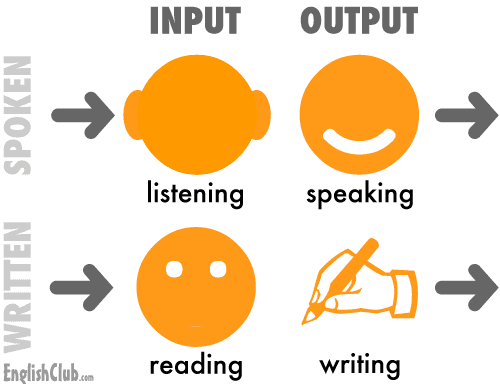
When we learn a language, there are four skills that we need for complete communication.
When we learn the English language, we usually learn to
"listen" first,
then to "speak,"
then to "read,"
and finally to "write."
These are called the four " Englishlanguage skills":

|
Teaching English as a Second or Foreign Language.ppt Size : 416.5 Kb Type : ppt |

|
|
videoplayback.3gpp Size : 1222.085 Kb Type : 3gpp |
|
|
Let's talk ENGLISH.pptx Size : 374.216 Kb Type : pptx |
|
|
videoplayback.3gp Size : 2400.132 Kb Type : 3gp |
|
|
videoplayback (1).3gp Size : 2050.208 Kb Type : 3gp |
Regular English Lesson Categories
Regular English lessons contain key sentences for many different scenarios that are used in everyday life.
This daily English section will help you because all the sentences are everyday sentences that are regularly used.
You don't have to worry about studying English sentences that are not used in everyday use.
Greeting
There are many ways to greet someone. We'll learn about the most common way to greet someone in this lesson.
I'll give a variety of example sentences.
Greeting someone you never met:
"Hi, my name is Steve. It's nice to meet you."
You can respond to this by saying,
"It's a pleasure to meet you. I'm Jack."
Another common question to ask is
"What do you do for a living?"
You can respond to this by saying,
"I work at a restaurant."
"I work at a bank."
"I work in a software company."
"I'm a dentist."
Usually, you will not need to ask for a name. It is implied that each person should say their name. But in case they don't, you can ask,
"What is your name?"
Many times, I don't hear the name. If you would like for them to repeat their name, you can say,
"What was that again?"
"Excuse me?"
"Pardon me?"
Small Talk
Many people believe small talk is very boring and not personable. Although that is true, there are many places where small talk is very important.
In the western culture, strangers talk to other strangers frequently. On the other hand, small talk is not so common in the eastern culture.
Because strangers are friendly to one another in the western culture, small talk is very important to master in regards to learning English.
One other place small talk is important is in an interview. That is why this session will be important to learn.
The best way to learn small talk is to provide many examples. So this lesson will be taught using an example format.
Small talk involves many different topics. We will have several sessions on small talk once we have covered other subjects such as sports, jobs, school, etc.
But for now, we will go through the basics of small talk conversation. To initiate small talk, we can use what we have learned from our previous several sessions:
One: "Hi Bill, how are you doing?"
Two: "I'm doing great. How are you doing?"
One: "I'm doing well myself."
Wasn't that simple? If you studied the material in prior sessions, this should be real easy for you.
Now that we have initiated the small talk, it's your responsibility to keep the conversation going.
In order to do so, you can talk about anything that is not too personal.
Let's first ask what the other person has been doing lately.
One: "What have you been up to lately?"
Two: "Well, I just started to work at the bank so I'm pretty busy learning everything."
You can elaborate on what you have learned to keep the conversation alive.
In this example, you are going to ask more questions about school and work.
One: "Does that mean you already finished school? I thought you had 1 more semester left."
Two: "I took summer courses, so I finished one semester early."
One: "It's great that you got a job. I'm really happy for you."
Two: "Thanks."
As you can now tell, the conversation is getting old. You have a choice of ending the conversation, or changing the topic.
Let's practice ending the conversation.
One: "We should get together for lunch sometime."
Two: "Yeah, that would be great."
One: "I'll call you sometime."
Two: "Ok. I'll see you later."
One: "Alright. See ya."
Movies - Example Conversation
Let's look at a couple of example conversations before going to the practice section.
Person A: "Hey John, I'm going to see The Matrix with Peter and Brad. Do you wanna come?"
Person B: "When are you guys going?"
Person A: "We're going to see the eight O'clock showing."
Person B: "That would be great. Where are you guys meeting?"
Person A: "We're meeting at the theater at seven thirty."
Person B: "Great. I'll meet you guys there."
Person A: "Hey Jill."
Person B: "What's up Mike?"
Person A: "I was wondering if you have any plans for tomorrow night."
Person B: "Umm... I don't think I have anything special for tomorrow. Why?"
Person A: "Do you want to see The Titanic with me?"
Person B: "I wanted to see that. Yeah. Let's go."
Person A: "What time is good for you?"
Person B: "How about seven thirty."
Person A: "Sure. I'll meet you at the theater at seven.
Favorite - What's your Favorite
The word favorite is used a lot in spoken English. It is very common to talk about your favorite things with your friends or acquaintances.
Topics can range from favorite movies, favorite TV shows, favorite food, favorite cars, etc.
Since there are so many favorite things in the world, you should pay close attention to this lesson.
Asking questions is the most common way to use the word favorite:
"Who is your favorite singer?"
"Who is your favorite person?"
"Who is your favorite athlete?"
"Who was your favorite ex-girlfriend?"
"Who was your favorite elementary teacher?"
Are you following me? It's very easy. Just change the word at the end and you can make dozens of sentences.
"What is your favorite show?"
"What is your favorite movie?"
"What is your favorite dessert?"
"What is your favorite program?"
"What is your favorite class?"
"What is your favorite game?"
"What was the title of your favorite song?"
"What was the name of your favorite sit-com?"
We used 'who' and 'what' in our sentences. It's possible to use 'where', 'how', and 'when', but the most common is 'what' and 'who'.
I'll provide a couple of sentences for the other words.
"Where is your favorite vacation spot?"
"When is your favorite time of day?"
"How is your favorite noodles cooked?"
It's not common, because even though it is grammatically incorrect, you can ask the same question with 'what'
"What is your favorite vacation spot?"
"What is your favorite time of day?"
Nobody is really going to notice and it's not a big deal. After this lesson is over, I suggest practicing with 'what' and 'who',
but don't bother with the others. It's not as important.
Hobby - Interactive Practice
Click on Listen All and follow along. After becoming comfortable with the entire conversation, become Person A by clicking on the Person A button.
You will hear only Person B through the audio file. There will be a silence for you to repeat the sentences of Person A. Do the same for Person B.
The speed of the conversation is native speed. Use the pause button if the pause between each sentence is too fast for you.
After practicing several times, you will be able to speak as fast as a native.
1Listen All | Person A | Person BA: "Hey Bob. Whatcha you doing?"
B: "I'm at home painting."
A: "I didn't know you paint. What type of painting is it?"
B: "I enjoy oil painting. I learned it in one of my extra classes in college."
A: "That sounds so interesting. I wish I learned a hobby."
B: "Hobbies are never too late to learn. They offer a variety of classes at the local community college. You should look into it."
A: "I think I will. Thanks for the info."
2Listen All | Person A | Person BA: "Hey Joanne. What are you up to?"
B: "I'm just watching some television."
A: "I'm so bored. I don't know what I'm going to do today and it is only ten in the morning."
B: "Me too. Do you think we are boring people?"
A: "I don't think we are boring. It's just that we don't have any hobbies."
B: "That's right. What do you think we should do as a hobby?"
A: "That all depends on what you like to do. For example, I like to doodle on the notepad, so I'm thinking about doing some real drawings."
B: "I like to play the piano for fun."
A: "Yeah. That can be a good hobby."
B: "Hobbies are great. I'm going to make a list of all the things I like to do."
A: "That's a great idea. I'm going to do the same."
Exercise - Questions
There are various types of exercise. Some people might think walking is exercise, and some other people will think weight lifting is exercise.
In the next couple of lessons, we will take a closer look at various types of exercise.
Exercising can be done in many different ways. Here is a small list to get us started:
Walking
Jogging
Running
Sports
Aerobics
Rowing (boat)
Commuting to work
Etc.
Here are some questions.
"Do you exercise at all?"
"Do you work out?"
"What type of exercising do you do?"
"Where is a good place to exercise?"
"Why don't you exercise?"
"Where do you usually jog?"
"How long do you take a walk for?"
"How often do you jog?"
"Where do you do aerobics?"
"How long do you usually run for everyday?"
College Related Topics
As you can see, these portions of our lessons are dedicated to school.
There are many things to learn here, so we are going to spend numerous lessons on school. But don't worry; only a couple will be geared towards classes.
The rest will be about night life, partying, and having a good time. Before we start learning about topics such as classes and examinations, let's learn some general university phrases.
The first type of speaking you will have to do is when you meet new people. During this time, you can engage in idle small talk.
Since you have learned small talk, feel free to use your new skills. On top of that, let's learn some new phrases that will help you.
"Where are you from?"
"What high school did you attend?"
"What are you going to major in?"
"What are you majoring in?"
"How many credits are you taking this semester?"
"What classes are you taking?"
"What year are you?"
"What is an easy class to take?"
"Where is the best place to hang out?"
"Are you in the dormitory?"
"Where do you live?"
"Why did you decide to come to this school?"
"What made you choose Berkeley?"
Many of the answer to these questions are general things you should already know.
But it never hurts to review again, so let's go over how we can answer some of these questions.
"Where are you from?"
"I'm from Seattle, Washington."
"I'm an exchange student from Seoul, Korea."
"I'm from Dublin, Ohio."
"I'm from Southern California."
Family and Friends
Cooking the meal together is a fun time to talk, share recipes and work together.
Here are some questions commonly used when cooking a meal together.
"You have a preference on which job to do?"
"Do you mind heating up some water on the stove?"
"Do you have any different ways to prepare this meal?"
"Would you like something to drink while we are cooking?"
"Do you mind setting up the table for us?"
"Can you turn the oven on to 360 degrees?"
If you are asked any of these questions, here are ways that you could respond.
"No, I really don't have a preference."
"Yes, I would really like to prepare the salad."
"No problem, I will heat the water up now."
"Sure I can heat it up. Do you mind it boiling?"
"I have a way to prepare this that my mom taught me."
"I don't really have any other ways. Let's just do what the recipe says."
"Sure, can I have a glass of water?"
"No thanks. I might just wait until dinner."
"Sure I can set the table."
"I have never set the table before. Do you have a particular way of doing it?"
"Yes, I can turn on the oven."
"No problem."
This is also a good time to talk about other subjects while sharing interests and learning more about each other.
If questions like these come up, just answer them the best you can. Everyone will have different opinions and answers about each of these personal topics.
"What is your favorite TV show?"
"Do you have a favorite book?"
"Do you have any brothers or sisters?"
"Where were you born?"
"Do you have any hobbies?"
"So how is work going?"